

Are Lemon Law Settlements Taxable in California? Key Facts You Should Know
Most California lemon law settlements are not taxable if they refund the purchase price of a defective vehicle or provide a replacement of equal value, as the laws are designed to protect consumers. Cash settlements can be taxable, particularly if the settlement includes punitive damages or compensation for additional expenses like lost income or emotional distress. Attorney fees paid directly to your lawyer are generally not considered taxable income. Both the IRS and California’s Franchise Tax Board generally follow these rules, but consulting a tax professional is recommended for any exceptions.
The Lemon Pros are experts in navigating the lemon law and defective vehicles. Since our practice area is focused on lemon vehicles, we have been able to secure compensation for thousands of happy clients. Contact us today to get a free consultation about your defective vehicle!
This blog explains how California lemon law settlements work, including what compensation is provided, which parts may be taxable, and practical guidance for reporting them to the IRS and state tax authorities.
Table Of Contents
- What Are Lemon Law Settlements in California?
- Real Example: How a Lemon Law Settlement Is Taxed in Practice
- Types of Lemon Law Settlements
- Are Lemon Law Settlements Taxable in California?
- IRS Rules and Role of California Franchise Tax Board
- The 3-Part Framework for Understanding Lemon Law Settlement Taxes
- How Do You Report Lemon Law Settlements on Your Taxes?
- Step 1: Break Down Your Settlement Into Taxable and Non-Taxable Parts
- Step 2: Identify Specific Components That May Affect Tax Treatment
- Step 3: Gather the Necessary Forms and Documentation
- Step 4: Understand How Legal Fees Are Treated
- Step 5: Report the Settlement Correctly on Your Tax Return
- Step 6: Consider State Tax Rules and Differences
- Step 7: Avoid Common Mistakes and Keep Detailed Records
- Step 8: Work With a Tax Professional When Needed
- What to Do After Receiving a Settlement?
- How Can You Maximize Your Lemon Law Settlement Agreement?
- What Are the Potential Mistakes When Reporting a Lemon Law Settlement and How Can You Avoid Them?
- Need Help with a Lemon Law Claim?
- Frequently Asked Questions
What Are Lemon Law Settlements in California?
Lemon law settlements in California provide compensation when new vehicles or leased vehicles have significant defects that cannot be fixed after a reasonable number of repair attempts. These settlements protect your legal rights by restoring you to your position at the time of the original purchase, often with help from a lemon law firm.
Under state law, manufacturers must offer a refund or replacement vehicle if the car meets specific criteria. A refund usually includes the vehicle’s purchase price, sales tax, licensing fees, and certain related expenses, while lease payments may be considered for leased vehicles. In some cases, you may receive cash or compensatory payments.
Unlike typical civil cases, these settlements are tied to warranty enforcement, which affects tax consequences. The IRS generally determines whether any portion is considered taxable income. Amounts that reimburse your purchase are often non-taxable, while elements like punitive damages or certain payments may be subject to taxation, creating potential tax liability and federal tax implications.
Since each settlement is different, factors like business use, deductions, and structure can impact your tax obligations or even push you into a higher tax bracket. Getting expert guidance helps you make informed decisions while ensuring compliance with applicable tax regulations.
Real Example: How a Lemon Law Settlement Is Taxed in Practice

To better understand how lemon law settlements are treated for tax purposes, consider this real-world scenario. A California driver purchased a new SUV for $48,000. After repeated repair attempts for transmission issues, the manufacturer agreed to a buyback settlement. The settlement included:
- $44,000 refund (after mileage offset)
- $2,000 for rental and towing expenses
- $3,000 in attorney fees paid directly to the lawyer
In this case, the $44,000 refund was not taxable because it represented a return of the original purchase price. The $2,000 reimbursement for expenses was also not taxable, as it covered out-of-pocket costs. The $3,000 in attorney fees was not treated as income to the consumer.
However, if the settlement had included additional compensation for lost wages or punitive damages, that portion would likely be taxable under IRS rules. This example highlights why breaking down each part of your settlement is critical when evaluating tax obligations.
Types of Lemon Law Settlements

Depending on the outcome of your lemon law settlement agreement, you may end up with one of the following resolutions:
Lemon Law Buyback
A lemon law buyback occurs when the manufacturer repurchases the vehicle. It's unlikely that you'll receive the full price back, as the amount is calculated from the time that the problem first started. As part of the buyback, you will need to surrender the car to the dealer or manufacturer. To help estimate the amount that the manufacturer may owe you, use our convenient lemon law buyback calculator
Replacement Vehicle
The dealer or manufacturer may choose to give you a new, comparable vehicle in exchange for the defective one. You would be given a similar car based on the fair market value and your purchase price. This vehicle must also be defect-free, or you will be able to file another lemon law claim.
Cash Settlement
In some cases, the manufacturer will pay you to keep the vehicle, known as a cash-and-keep settlement. This refund of your money is for the inconvenience and is usually only offered if the defect is something that can be lived with. Once you are paid, there can no longer be any more claims about this defect, so that's something to consider.
Are Lemon Law Settlements Taxable in California?
The California Franchise Tax Board is responsible for collecting all of the taxes in the state, and it differs from federal guidelines, so you may be responsible for paying both in the end. However, most Lemon law claims are considered tax-free due to them being compensation for a defective vehicle you already paid for.
Whenever you are compensated for something that you've already paid for or a loss you've incurred, it's not normally taxed. That's how the federal and state tax authorities look at the compensation you get for having a defective vehicle. You are simply receiving the money back that you've already spent, meaning it's not considered income.
“In most cases, Lemon Law settlements are structured to make the consumer whole, which is why refunds and replacements are typically not taxable. The key issue is whether any portion goes beyond reimbursement, such as punitive damages or lost income, which can trigger tax liability,” says Michael Saeedian, Founder of The Lemon Pros.
There are some exceptions to these rules. For example, if money is paid to a customer for interest or punitive damages, these settlements may be considered taxable. There are also different regulations for vehicles used personally versus those that are commercial, so it's always best to consult with your tax professional to find out how to report Lemon law settlement on taxes.
What Is the Tax Treatment of a California Lemon Law Settlement and Legal Fees?
Revisiting the various Lemon law settlement options outlined above, let's examine whether you may be responsible for taxes or not. A Lemon law buyback isn't going to be considered income because you are simply receiving back the money you've already spent on the car. This money can then be used to purchase another vehicle.
The same is true with replacement vehicles. Because you are being supplied with a vehicle of equal value to the one you surrender, there are no taxes involved. However, a cash settlement may have different implications. Because this money isn't being provided as a refund but rather compensation, you may be liable for some taxes.
According to the National Highway Traffic Safety Administration (NHTSA), vehicle defects are widespread, with over 30 million vehicles recalled in a single year in the U.S. This highlights how common serious automotive issues can be.
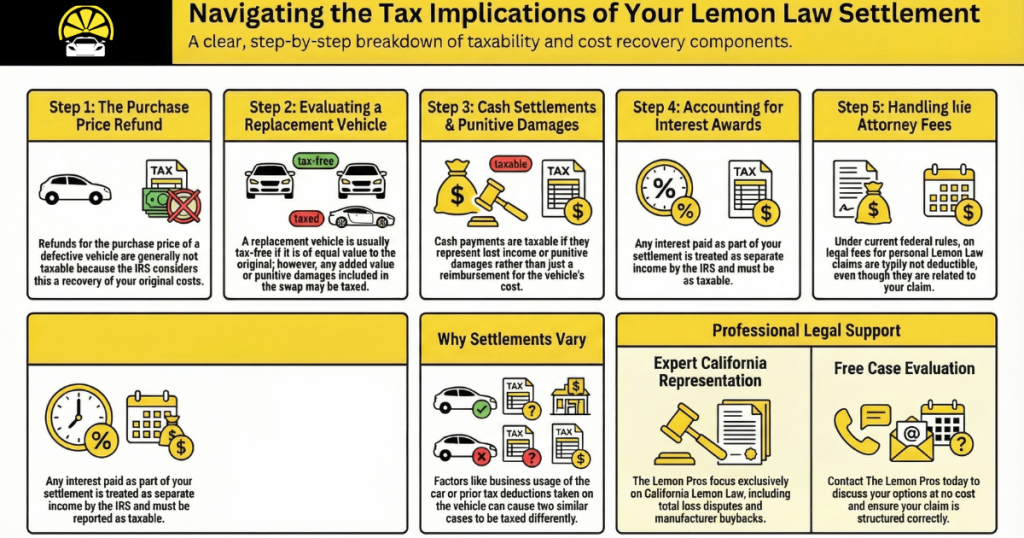
It is important to evaluate the role of legal fees in the mix as well. Any attorney fees are considered an expense. Therefore, the amount paid to the attorneys may be deductible from your final taxation evaluation. To help you quickly understand which amounts are taxable and what the IRS takes into account when reporting, the table below breaks down common settlement components.
| Settlement Component | Taxable? (Yes/No) | Notes / IRS Guidance |
|---|---|---|
| Refund of purchase price | No | Refunds for the original vehicle purchase are generally not taxable as they simply return the money spent. |
| Replacement vehicle | No (unless higher value) | Replacement vehicles are typically not taxable unless the replacement is worth more than the original vehicle. |
| Cash settlements | Yes (sometimes) | IRS considers cash payments taxable if they include lost income, punitive damages, or compensation beyond the original purchase. |
| Interest awarded | Yes | Interest paid as part of a settlement is generally taxable and must be reported as income. |
| Attorney fees paid to counsel | No | Fees paid directly to your attorney are generally not considered taxable income, but legal fees for personal claims are usually not deductible. |
IRS Rules and Role of California Franchise Tax Board

The Internal Revenue Service (IRS) is responsible for federal taxes, while the California Franchise Tax Board oversees everything within the state. Both have civil code sections regarding property settlements, such as those occurring with vehicles. Here are a few of the codes and regulations worth researching further:
Internal Revenue Code (IRC) Section 104: This section relates to any compensatory damages, stating that any compensation for physical sickness or physical injury is not taxable. On the other hand, punitive damages and compensation for emotional distress can be seen as income and are, therefore, taxable.
IRC Section 61: Through this section, we receive the definition of gross income. Basically, it's defined as all income from any source that isn't excluded by law. Under this section, some settlements for interest and punitive damages could be considered taxable.
IRS Publication 4345: In this publication, deeper insight is given about judgments and settlements, although there's no direct reference to Lemon Law settlements.
California Revenue and Taxation Code (RTC) Section 17201: This reference applies directly to California law, defining gross income and the connection to what is considered taxable.
The 3-Part Framework for Understanding Lemon Law Settlement Taxes
It can be difficult to understand how Lemon Law settlements are taxed, particularly when various settlement components are handled differently by tax authorities. It is easier to determine what is and is not taxable when complicated regulations are broken down into a straightforward framework rather than attempting to interpret them all at once. To simplify how Lemon Law settlements are taxed, you can apply this three-part framework:
- Recovery vs. Income - Ask whether the payment is simply returning money you already spent. Refunds and reimbursements are typically not taxable, while additional compensation may be.
- Purpose of Payment - Identify why the payment was made. Amounts tied to lost income, punitive damages, or interest are more likely to be taxed.
- How the Settlement Is Structured - The way your settlement is written matters. A clearly itemized agreement makes it easier to separate taxable and non-taxable portions and reduces audit risk.
Using this framework helps you quickly assess your potential tax exposure before filing.
How Do You Report Lemon Law Settlements on Your Taxes?

It is important to comprehend how the IRS evaluates each component of a lemon law settlement when filing your taxes. Different parts of the settlement may be handled differently for tax purposes depending on whether your claim involved a new car or a leased vehicle. Punitive damages, for example, may be taxable as part of your settlement, but other amounts might not. You can avoid mistakes and maintain compliance with tax regulations by understanding how to appropriately classify each component.
Step 1: Break Down Your Settlement Into Taxable and Non-Taxable Parts
Start by identifying what your settlement includes. Lemon law settlements typically consist of a refund for the purchase price or lease payments and an amount for attorney’s fees. Refunds for the purchase price of a vehicle due to the Lemon Law are generally not taxable, and if you receive a replacement vehicle, it is typically not taxable unless it is worth more than the original.
However, cash settlements can be subject to taxation, especially if they include lost income or emotional distress. The IRS does not specifically address lemon law settlements, but generally considers any income from a settlement taxable unless excluded by law.
Step 2: Identify Specific Components That May Affect Tax Treatment
Look closely at each portion of the settlement. If part of your Lemon Law settlement reimburses repair costs, towing, or rental fees, those amounts are typically not taxable income. On the other hand, if a portion includes punitive damages or compensation beyond your actual loss, that portion may be taxable. If you used the vehicle for business use or previously claimed deductions, the refund could be subject to taxation.
For example, if you used your vehicle partially for business and previously claimed depreciation, a portion of your settlement could be taxable. Similarly, if your settlement includes compensation for missed work due to repeated repairs, that amount may need to be reported as income.
Step 3: Gather the Necessary Forms and Documentation
Keep all settlement agreements, payment breakdowns, and receipts. Manufacturers may issue a Form 1099-MISC for any taxable portion of the settlement. If you received a 1099 form from the manufacturer, it is important to consult a tax professional to understand the tax implications of the settlement and how to properly report it.
Step 4: Understand How Legal Fees Are Treated
Attorney fees are handled differently under current tax rules. Attorney fees paid directly to counsel may not be taxable income, but under current federal tax laws, legal fees for personal claims like a lemon law suit are generally not deductible. This distinction is important when calculating your final tax position.
Step 5: Report the Settlement Correctly on Your Tax Return
Only the taxable portions of your settlement should be reported as income. If you received compensation that qualifies as an exclusion, those amounts are generally not included in your taxable income. Make sure your reporting aligns with IRS guidance and any forms issued.
Step 6: Consider State Tax Rules and Differences
The California Franchise Tax Board generally follows IRS rules regarding the taxation of Lemon Law settlements, but there may be exceptions. While California’s Franchise Tax Board generally follows IRS rules regarding the taxation of lemon law settlements, you should still verify if any state-specific adjustments apply.
Step 7: Avoid Common Mistakes and Keep Detailed Records
A common mistake is reporting the entire settlement as taxable or failing to report taxable portions shown on a 1099 form. Maintain detailed records of your settlement breakdown, related expenses, and communications. This helps support your position in case of an audit.
Step 8: Work With a Tax Professional When Needed
Consulting with a tax expert familiar with both state and federal regulations is crucial to guarantee that you meet all obligations and prevent any unforeseen tax liabilities. Professional guidance helps ensure accurate reporting, proper classification, and full compliance with applicable tax laws.
What to Do After Receiving a Settlement?
Once you receive the reimbursement payment or replacement vehicle, you want to reach out to a tax professional. While an attorney can supply some general information, only an accountant is going to understand how this settlement affects your tax return. You will need to report the settlement in some cases, and this is done by a professional who knows this area.
You also want to continue to keep a record of everything that occurred. This should include the original documentation that was needed to file the claim, along with any records from the payout and settlement. We recommend reviewing your settlement agreement line by line with a tax professional before filing. Pay close attention to how each payment is labeled, as this directly impacts how it should be reported to the IRS and state tax authorities.
What Are the Average California Lemon Law Settlements?
The Lemon law settlement in California is typically between $5,000 and $100,000, depending on the type of vehicle you drive, how long you've had it, and the severity of the defects, while the average tends to be between $40,000 to $50,000.A consultation with a qualified attorney can help you estimate a possible settlement so you know what to expect.
How Can You Maximize Your Lemon Law Settlement Agreement?
As a consumer dealing with a defective car, you want to do everything in your power to receive as much back as possible. A few simple tips will help you to get the most out of your Lemon Law settlement:
- Start by documenting everything. By having all of the evidence documented and in order, you have a better chance of proving your Lemon Law case. You also have the necessary documentation to get the compensation for smaller expenses, such as tow bills.
- Spend time understanding your rights and learning about local laws. Knowledge is power in this situation, so it's wise to read up on the regulations.
- Don't attempt to file a claim without an experienced lemon lawyer. The Lemon Pros specialize in claims for defective vehicles and know how to work with the manufacturers for positive outcomes. Contact us for a free consultation to see what you may be owed.
- Calculate all of your damages. If there were medical bills, rental car expenses, or other things that you put money out for, make sure these are included with the request.
- Consider your settlement options. As a consumer, you have several options to consider. Determine which of the settlement choices may suit your needs best and be willing to push for that one. Even though that's the option you want, it's also good to be willing to negotiate if the right settlement comes along.
- Pay close attention to all deadlines. You don't want to miss out on compensation because you forgot about a deadline. A qualified lawyer will handle most of this for you, ensuring that you have less to stress about.
What Are the Potential Mistakes When Reporting a Lemon Law Settlement and How Can You Avoid Them?
Making a mistake can cost you plenty in the end. To avoid penalties, consider these helpful tips:
Keep proper records. Document everything, including the settlement amount, and show the paperwork to your tax professional.
Avoid filing on your own. Even if you know a little about taxes, the regulations can be tricky when dealing with a Lemon Law settlement. Let a professional help with the process.
Choose an expert. Do research before choosing a tax professional. Ask friends and family for recommendations or read online reviews.
In addition to hiring a tax expert, don't forget to take advantage of having a Lemon Law attorney. Your experienced attorney is available after the settlement in the same way they were during the claim. While they aren't going to have all of the tax answers available for you, they can lead you in the right direction.
Need Help with a Lemon Law Claim?
While most Lemon Law settlements are not taxable, there are situations where tax liability can arise. Factors such as business use, prior deductions, and how the settlement is structured can all affect the outcome. This is why two seemingly similar cases may be taxed differently.
For great advice, you want a qualified lemon law attorney on your side, such as The Lemon Pros. Our team of Lemon Law attorneys in California focuses exclusively on California Lemon Law cases and has helped drivers pursue claims, total loss disputes, and manufacturer buybacks. Contact us today for a free case evaluation to discuss your options at no cost.
Frequently Asked Questions
Lemon law settlements can be confusing when it comes to taxes. Here are simple answers to common questions to help you understand what the IRS considers taxable and what is not.
Do I Owe Taxes on a Lemon Law Settlement Refund?
Refunds for the purchase price of a defective vehicle are generally not taxable because they simply return what you originally paid. The IRS considers these amounts a recovery of costs rather than income, unless additional compensation is included.
Is the Cash Settlement From a Lemon Law Claim Taxable Income?
Cash settlements can be taxable depending on what the payment represents. If the settlement includes punitive damages or amounts for lost income, those portions are more likely to be taxed.
Can I Deduct Attorney Fees Related to Lemon Law Cases on My Taxes?
In most cases, attorney fees for personal lemon law claims are not deductible under current federal tax rules. Even though the IRS considers the nature of the claim, these legal fees typically do not qualify for deductions.
Are Replacement Vehicles Considered Taxable Income?
Replacement vehicles are usually not taxable if they are of equal value to the original defective vehicle. However, if the settlement includes punitive damages or added value beyond the original purchase, that portion may be subject to tax.
Does Interest Awarded on a Lemon Law Settlement Count as Income?
Yes, interest paid as part of a settlement is generally taxable and must be reported as income. The IRS considers interest separate from the main settlement, meaning it is typically always subject to taxation.
Legal Disclaimer: This content is provided for informational purposes only and does not constitute legal advice. Lemon Law eligibility and outcomes vary based on individual circumstances, vehicle history, and applicable laws. Reading this article does not create an attorney-client relationship. For legal advice regarding your specific situation, consult a qualified Lemon Law attorney.