

Does CarMax Buy Cars with Mechanical Problems?
Yes, CarMax will generally buy cars with mechanical problems, including vehicles with engine trouble, transmission issues, or warning lights. Founded in 1993 as a subsidiary of Circuit City, CarMax has grown into one of the largest used car retailers in the United States. The company is known for its structured appraisal process, which factors repair costs and overall condition into the offer amount. While no used car retailer is completely free from complaints, CarMax is widely considered one of the more trustworthy options for buying or selling used vehicles.
The Lemon Pros protect consumers against car dealerships that have sold them a lemon. With lemon cars as our main practice area, we've secured millions of dollars in settlements for our clients. Contact us today for your free consultation.
In this guide, we show you the signs that you have a lemon car, how to file a claim, and discuss the practices of CarMax in comparison to the used car market.
Table Of Contents
- Can You Sell a Car With Mechanical Problems to CarMax?
- The Repair-or-Sell Rule We Recommend
- Does CarMax Negotiate on Offers for Cars With Mechanical Problems?
- Selling to CarMax vs Other Buyers When Your Car Has Mechanical Problems
- Selling a Car With Transmission Problems to CarMax
- What Are the Signs That Your Car Might Be a Lemon?
- Does CarMax Sell Lemon Cars?
- How Do You File a Lemon Law Claim Against CarMax?
- What Can You Get from a Lemon Law Case?
- Can I Sue CarMax for Selling Me a Bad Car?
- How Can You Contact CarMax Customer Service When Selling a Car With Problems?
- What Cars Will CarMax Not Buy?
- Need a Skilled Lemon Law Attorney for Your Used Car?
- Frequently Asked Questions
Can You Sell a Car With Mechanical Problems to CarMax?
Selling a car with mechanical problems to CarMax is usually a straightforward process, even if the vehicle has serious issues. CarMax will generally still make an offer rather than refuse the car altogether, although the amount may drop significantly depending on repair costs and overall condition.
Start by gathering your paperwork, including the title, registration, payoff information, and a valid ID. If you still owe money through a bank or credit union, CarMax may need to connect with the lender to verify the payoff amount before the sale can move forward.
Next, bring the vehicle to a local CarMax store for an appraisal. The company analyzes the year, make, model, mileage, and mechanical condition when creating the offer. A person from the appraisal team will inspect the vehicle and may test-drive it if possible. Mechanical problems, warning lights, accident history, and repair needs all factor into the final number.
Before the appointment, it helps to create realistic expectations. You do not need to fully repair the vehicle, but basic preparation can improve the experience buying or selling process. Removing trash, cleaning the interior, and bringing maintenance records can give the appraiser a clearer picture of how the car was maintained over the course of ownership.
Cars with major mechanical problems may receive lower offers because CarMax factors repair expenses into the appraisal. Vehicles that do not meet CarMax’s retail standards are often sold through wholesale auctions instead of being displayed on the sales page at the store.
Once the inspection is complete, CarMax will provide a written offer that you can accept immediately or take home and compare with the rest of the market. Many offers remain valid for several days, giving sellers an advantage if they want time to compare options before making a final decision.
The Repair-or-Sell Rule We Recommend

At The Lemon Pros, we have worked with many California drivers trying to decide whether it makes more financial sense to repair a mechanically damaged vehicle or sell it to CarMax. Over time, we have found that consumers often spend thousands of dollars chasing recurring problems without realizing the vehicle may qualify for Lemon Law protections or that selling the car could ultimately be the smarter option.
Since every situation is different, we generally recommend using a simple three-part framework before deciding whether to repair a mechanically damaged vehicle, pursue a Lemon Law claim, or sell it to CarMax.
- Compare Repair Cost to Vehicle Value: If repairs approach 40% to 50% of the vehicle’s market value, selling may make more financial sense.
- Review the Warranty Status: Vehicles still covered under a manufacturer's warranty may qualify for free repairs or even Lemon Law protection, depending on the defect history.
- Consider Reliability Trends: If the same issue keeps returning after multiple repair attempts, continuing repairs can quickly become more expensive than replacing the vehicle altogether.
This process helps many consumers avoid sinking thousands of dollars into a car that may continue breaking down.
Does CarMax Negotiate on Offers for Cars With Mechanical Problems?

CarMax generally does not negotiate on vehicle purchase offers, including cars with mechanical problems. The company follows a no-haggle pricing policy, which means the appraisal amount you receive is typically the final offer.
When creating the offer, CarMax factors in the vehicle’s year, mileage, market value, and repair costs. Serious issues like engine damage, transmission failure, or frame damage can cause the offer to drop significantly, sometimes by half compared to a similar vehicle in good condition. Cars that do not meet CarMax’s retail standards are usually sold through wholesale auctions instead of being placed on the sales lot.
If the offer is lower than expected, sellers still have alternatives. Some people compare offers from local dealerships, private buyers, or online car-buying services before making a decision. Others choose to repair minor issues at home before returning for another appraisal, although expensive repairs do not always increase the value enough to justify the cost.
Selling to CarMax vs Other Buyers When Your Car Has Mechanical Problems
If your car has mechanical problems, it helps to compare multiple selling options before accepting an offer. Some buyers focus on convenience, while others may pay more but require additional effort, repairs, or negotiation.
| Buyer Type | Acceptance of Mechanical Issues | Offer Process | Convenience | Price Expectation |
|---|---|---|---|---|
| CarMax | Generally accepts cars with engine, transmission, or warning light issues | Fixed appraisal based on condition, mileage, and repair costs | High, quick appraisal and same-day offers | Moderate |
| Private Buyer | Depends on the buyer’s comfort level with repairs | Negotiated a sale between individuals | Lower, requires listings, meetings, and paperwork | Potentially highest |
| Junkyard | Accepts severely damaged or non-running vehicles | Based mostly on scrap or parts value | Moderate, some offer towing | Lowest |
While CarMax offers convenience and speed, sellers should understand the trade-off involved. Private buyers may sometimes pay more for vehicles with repairable issues, but private sales also involve more risk, negotiation, and time spent coordinating meetings or handling paperwork.
Junkyards and salvage buyers are often the easiest option for severely damaged vehicles, especially non-running cars, but they usually provide the lowest payouts because the vehicle is valued primarily for scrap or parts.
Selling a Car With Transmission Problems to CarMax
At The Lemon Pros, we recently worked with a California driver who was struggling to sell a 2016 SUV with recurring transmission slipping, delayed shifting, and dashboard warning lights. After multiple failed repair attempts at the dealership, the client explored several selling options and received an offer of less than $2,000 from a local dealer because of the vehicle’s mechanical condition.
The client then brought the SUV to CarMax, which still completed a written appraisal despite the ongoing transmission issues. Although the CarMax offer was lower than the vehicle’s normal market value, the client chose to move forward because the process was fast, straightforward, and avoided the complications of trying to sell a problematic car privately.
During our review of the repair records, however, our attorneys identified something more important. The SUV had undergone multiple transmission repair attempts while still covered under the manufacturer’s warranty. In our experience, repeated repair visits for the same substantial defect are often one of the strongest warning signs that a vehicle may qualify under California Lemon Law protections.
As Michael Saeedian explains, “Many consumers assume selling a defective vehicle is their only option, but repeated repair attempts can sometimes open the door to a manufacturer buyback or compensation under California Lemon Law.”
This situation highlights an important point that many consumers miss. Selling a mechanically damaged vehicle to CarMax may solve the immediate problem, but drivers should first determine whether they may also qualify for compensation, a vehicle buyback, or a replacement under Lemon Law.
What Are the Signs That Your Car Might Be a Lemon?

Is your car a lemon? If the car has significant defects that interfere with its use, safety, or value, you may be due compensation. For cars to qualify for Lemon Law cases, they must meet all state and federal laws. In California, the Song-Beverly Consumer Warranty Act is the set of guidelines for Lemon Law. Most regulations protect new cars, but the state also has a used car Lemon Law. However, the vehicle must meet the following conditions:
- Be covered under warranty.
- Be within the timeframe for a claim.
- Have unrepairable defects (four attempted repairs are required for most claims, unless it's safety-related, which requires two attempts)
- Must have been purchased from a dealership, not a private sale
If the used car you purchase is constantly breaking down or in the shop for repairs, you may be able to file a claim. Because of the vagueness of the California Lemon Law, most defects qualify if they can't be repaired. Therefore, the claim could include transmission failure, engine defects, and electrical system glitches.
Does CarMax Sell Lemon Cars?
CarMax strives to sell high-quality used cars and rarely has issues with lemon vehicles. However, there have been occasional complaints about a lemon that has made its way onto the lots.
CarMax sources its vehicles from several locations.
- Trade-ins: Customers sell their cars to CarMax when purchasing another model. These cars are subject to inspection before being resold.
- Auctions: CarMax purchases from dealer-only auctions, including repossessions, previously rented, and off-lease vehicles.
If a car doesn't meet CarMax's strict standards, it will be sold at a wholesale auction instead of being put on the lot. While there have been minor complaints about undisclosed problems, warranty issues, and customer service concerns, the majority of CarMax locations receive favorable reviews. Most people are pleased with the processes that CarMax has in place, including the 125+ point inspection and return policy.
CarMax's Vehicle Inspection and Certification Process
CarMax completes a 125+ point inspection on every vehicle before it goes on the lot. This inspection covers all of the major mechanical, electrical, and cosmetic systems.
If the vehicle doesn't pass the inspection, CarMax may choose to repair the issues. Otherwise, the car is sent to auction to be resold at wholesale.
CarMax's Return Policy and Consumer Protections
All of CarMax's cars come with a 90-day/4,000-mile limited warranty. This warranty includes guaranteed coverage on the following systems:
- Frame and body
- Engine
- Driveshaft
- Transmission
- Differential
- Fuel system
- Cooling system
- Electrical system
- Steering
- Suspension
- Brakes
- Restraint system
- Exhaust system
- Tires and wheels
There are also extended warranty plans available, known as MaxCare. These offer an additional cost to the buyer, but provide more peace of mind.
Furthermore, CarMax has a 10-day Money-Back Guarantee, allowing you to return the vehicle if it's in the same condition as when you purchased it.
How Do You File a Lemon Law Claim Against CarMax?

If you purchased a defective car from CarMax, it is important to follow these steps carefully. Otherwise, you could miss out on valuable compensation.
Step 1: Gather Evidence to Support Your Lemon Law Claim
Most Lemon law complaints are lost because of a lack of documentation. Therefore, you must do everything possible to keep a record of the defects and repair history. Document every visit to the repair shop, with the date, reported problem, and resolution clearly described. On the repair orders, see if you can have the technician write a few notes about the repairs or the inability to fix the problem.
You should also keep all records of communication between you and the dealer or manufacturer. If you've had text messages, phone calls, or emails, you should have a record of them. Take some photos and videos of the problem. Try to illustrate what's happening and discuss how it's affecting ownership.
Finally, you need to keep copies of all the expenses. While this includes the purchase price and financing agreement, you also need to think about your downtime. If you've had to pay for a rental car or lost time at work because you didn't have a car, these items should be tracked.
Step 2: Notify CarMax and Request a Resolution
If your car qualifies as a lemon, you have a legal responsibility to write to the dealership and request a resolution. In your formal complaint letter, clearly state your concerns and outline the problems. Be clear about the resolution you want.
With your letter, provide all the documentation that proves what you are saying. Attach copies of all the service records and invoices. You can also set a reasonable deadline for a resolution, typically 10 to 14 days. If CarMax doesn't reply before the deadline, you may want to follow up and escalate the complaint with a higher-level customer service representative. You should also consider mediation services that can be held with the help of your attorney.
Step 3: File a Complaint with Consumer Protection Agencies
Along with filing a Lemon Law complaint, there are other steps you can consider taking to protect fellow consumers. Start with the Federal Trade Commission (FTC), which tracks complaints against businesses when fraud occurs. Another good avenue is with the Better Business Bureau (BBB). You can write a review for the dealership and leave a formal complaint.
Aside from these, contact your state attorney general's office to file a complaint, along with the California Department of Motor Vehicles (DMV). Finally, if your vehicle was financed through CarMax, the Consumer Financial Protection Bureau (CFPB) may be able to settle a dispute.
Step 4: Consult a Lemon Law Attorney
If CarMax won't resolve the issue, you should get a Lemon Law attorney to help. Your California lawyer will review the facts of the case and help you get everything that you deserve. Research the lawyer and make sure they have experience with lemon cars. It's also helpful if you review your legal rights, so you know what you are entitled to.
The best part of working with a Lemon Law attorney is that many work on a contingency basis. This simply means that you won't need to pay anything up front. Instead, your attorney's fees will be taken from the settlement, or the manufacturer will be responsible for paying.
The Lemon Pros know how to get results. Contact us today for a free case evaluation.
What Can You Get from a Lemon Law Case?
Depending on the situation, you may be able to get a refund or replacement vehicle from your Lemon Law claim.
Refund of the Purchase Price
After a review of the evidence, you may receive a refund of the price you've paid for the car. The value you receive depends on how many miles you've put on the car since the sale and what other fees have been spent. For example, you may be able to receive your taxes, registration fees, and other expenses back. In exchange for the compensation, you will need to return the vehicle.
Replacement Vehicle
If you've been dealing with numerous issues that can't be repaired, you can also ask for a replacement vehicle. You don't need to be concerned with the other vehicle having the same problems because it must be defect-free. A replacement will be the same make and model, with similar mileage and features. You will be required to return the vehicle before receiving the replacement.
Cash Settlement
Depending on what you are dealing with, you may prefer a small Lemon Law cash settlement. For example, if there's a light on the dashboard that can't be turned off, you may consider keeping the car because there's nothing seriously wrong. A small cash settlement can cover the depreciation of the lemon car, but it can make it worth your time to hold onto.
A lawyer will help steer you in the right direction. You should never sign an agreement without understanding the future ramifications of the decision. You also don't want this option if there's a serious threat to your safety because of the defect.
Reimbursement for Repair Costs
If you had to pay out of pocket for any repairs, the dealership may be responsible for covering your costs. Make sure you keep all of the invoices and receipts if you want to get compensated. In addition to the repair costs, you may also get payment for incidental fees, such as a rental car or towing bills. If your case goes to court, the judge will want receipts for everything.
Can I Sue CarMax for Selling Me a Bad Car?
There are many reasons to consider suing a car dealership, especially if you were sold a lemon. Lawsuits are possible against CarMax, but you may do better by trying to negotiate with a lawyer representing you as the buyer first. Let a Lemon Law attorney review your warranty and state laws to see what you are entitled to.
Sadly, if you've purchased a car as-is, you may not have any recourse if there's something wrong. That's why so many people trust buying from CarMax because of the warranty and refund policy.
Your best bet is to get a lawyer involved at the beginning of the case. Do not wait to find out what you are entitled to. You could easily miss out on the timeframe to file a lawsuit. Days matter, so there's no room for delay.
How Can You Contact CarMax Customer Service When Selling a Car With Problems?
If you have questions about selling a vehicle with mechanical issues, CarMax customer service can help explain the appraisal process, required paperwork, title transfers, and how repair costs affect your offer.
The official CarMax customer service number is (800) 519-1511, and the company also provides support through its online help center and local store locations. You can also visit the official support page at www.carmax.com/help-center.
Customer support representatives can help verify documents, connect you with the correct department, and explain what to expect if your car has major mechanical problems. They may also walk you through the appraisal process, including how CarMax analyzes the year, make, model, mileage, and repair costs before creating an offer.
In most cases, even vehicles with serious mechanical problems will still receive an appraisal, although the offer may be lower. Cars that do not meet CarMax’s retail standards are typically sold at wholesale auctions to other dealers instead of being placed on the sales lot.
Sellers should also expect support agents to explain what paperwork is needed, including the title, registration, payoff information, and identification. If there is an active loan, CarMax may need to connect with your lender before the transaction can be completed.
What Cars Will CarMax Not Buy?
While CarMax buys many vehicles with mechanical problems, there are some cars it may refuse to purchase altogether. In most cases, the company prefers to make a lower offer rather than reject a vehicle, but certain conditions can disqualify a car from the appraisal process.
Vehicles with severe frame damage, extensive fire or flood damage, or major missing parts are more likely to be declined. Cars that cannot be legally sold because of title issues may also be rejected. For example, missing titles, unresolved liens, altered VINs, or certain salvage-title situations can create legal problems that prevent the sale from moving forward.
CarMax may also refuse vehicles with extreme mechanical damage if the repair costs are too high or the car cannot safely be transported or inspected. Non-running vehicles missing engines, transmissions, airbags, or other essential components are harder to process because they may not meet auction or wholesale standards.
In some situations, state laws and consumer protection rules also affect what vehicles can legally be purchased or resold. Sellers are generally expected to disclose known issues accurately during the appraisal process, especially if the car has been declared salvaged, rebuilt, or structurally damaged in the past.
Even when CarMax declines a vehicle for retail purchase, many problematic cars that do not meet retail standards are typically redirected to wholesale auctions, where other dealers may still purchase them for repair, parts, or rebuilding.
Need a Skilled Lemon Law Attorney for Your Used Car?
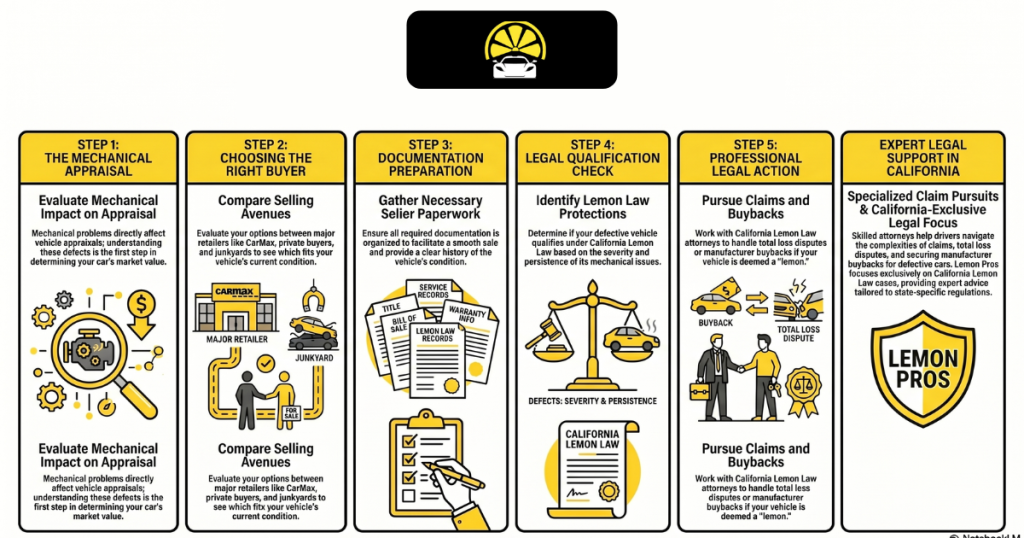
Many articles discussing CarMax only explain whether the company buys damaged cars. This guide goes further by explaining how mechanical problems affect appraisals, when a defective vehicle may qualify for Lemon Law protections, what paperwork sellers need, and how CarMax compares with private buyers and junkyards. Our goal is to help consumers understand both the sales process and the legal protections available when a vehicle develops serious defects.
For great advice, you want an experienced attorney on your side, such as the Lemon Pros. Our team of Lemon Law attorneys in California focuses exclusively on California Lemon Law cases and has helped drivers pursue claims, total loss disputes, and manufacturer buybacks. Contact us today for a free case evaluation to discuss your options at no cost.
Frequently Asked Questions
In the process of writing this blog, we came across some commonly asked questions concerning CarMax and the purchase of vehicles with mechanical problems. We did our best to answer.
How To Sell a Vehicle With Mechanical Problems?
Start by gathering the title, registration, and service records before taking the vehicle for an appraisal. Be honest about known issues because mechanical problems will affect the final offer amount.
What Is the $3000 Rule for Cars?
The $3000 rule is a budgeting guideline suggesting that annual repair costs should not exceed the car’s value by a significant amount. If repairs are approaching several thousand dollars, many owners choose to sell or replace the vehicle instead.
Do You Have To Disclose Mechanical Issues to CarMax?
Yes, sellers should disclose known mechanical issues during the appraisal process. CarMax will still inspect the vehicle, but accurate information helps avoid delays or changes to the offer.
What Cars Will CarMax Not Buy?
CarMax may refuse cars with severe frame damage, missing titles, altered VINs, or major missing parts. Vehicles with legal ownership issues or extreme damage may also be declined.
How Long Can CarMax Return a Car You Sold to Them?
Once CarMax completes the purchase and paperwork, the sale is usually final. In rare cases involving title problems, fraud, or undisclosed legal issues, the company may contact the seller afterward.
Legal Disclaimer: The information above describes general patterns and is not legal advice for your specific situation. Past results do not guarantee future outcomes. Lemon law remedies and the qualifying criteria vary by state. Reading this article does not create an attorney-client relationship. Consult a licensed attorney to evaluate the facts of your case.