

How To Win a Lemon Law Case Without a Lawyer
A lemon law is a consumer protection law that requires manufacturers to repair, replace, or refund vehicles with serious defects that affect their safety, use, or value. To win a lemon law case without a lawyer, you need to keep detailed records of all repairs, complaints, and communication with the dealership or manufacturer. You must also give the dealer a reasonable number of attempts to fix the issue while tracking how long the vehicle stays in the shop. Finally, file a formal complaint with the appropriate state agency or manufacturer dispute program and present clear evidence to support your claim.
The Lemon Pros are experts in navigating the Lemon Law and defective vehicles. Since our practice area is focused on lemon vehicles, we have been able to secure compensation for drivers. Contact us today to get a free consultation about your case!
This guide explains the basics of Lemon Law, how to start a claim, and tips to help you win your case.
Table Of Contents
- How Can You Win a Lemon Law Case Without a Lawyer?
- Step 1: Understand How Lemon Law Applies to Your Vehicle
- Step 2: Gather Detailed Documentation
- Step 3: Communicate Directly with the Manufacturer
- Step 4: Review Settlement Offers Carefully
- Step 5: File a Complaint or Request Arbitration if Required
- Step 6: Prepare for Legal Proceedings if Arbitration Fails
- Step 7: Avoid Common Pitfalls
- Step 8: Consider Consulting a Lemon Law Attorney
- The 5-Step Lemon Law Success Framework
- What Are the Common Challenges When Handling a Lemon Law Case Without Legal Representation?
- What Are Your Rights Under the Lemon Law for Leased and Used Cars?
- How Do Dealerships Handle Lemon Law Cases and What Are Your Rights During the Process?
- Lemon Law Protections for New vs. Used vs. Leased Vehicles
- Lemon Law Process: With a Lawyer vs. Self-Representation
- How Can You Win a Lemon Law Case and Maximize Your Compensation?
- Case Example: How One Driver Won Without a Lawyer
- How Much Does It Cost to Hire a Lemon Law Attorney?
- Getting Ready for a Lemon Law Case?
- Frequently Asked Questions
How Can You Win a Lemon Law Case Without a Lawyer?

It can be intimidating to handle a lemon law claim on your own, but it is possible with careful preparation and documentation. To safeguard your rights and obtain a just lemon law settlement, it is essential to comprehend the procedure, maintain thorough documentation, and speak with the manufacturer directly. In order to maximize your chances of success and avoid common mistakes, this guide offers a clear road map for self-representation.
Step 1: Understand How Lemon Law Applies to Your Vehicle
Start by confirming that your state’s lemon law applies to your situation. Typically, the law applies when your vehicle has a substantial defect that substantially impairs its use, safety, or value. Each state has specific qualifications, and some automatically consider a vehicle a lemon if it is out of service for 30 total days. Understanding this is the real question before you begin any legal proceedings.
Step 2: Gather Detailed Documentation
Maintaining thorough records of each repair attempt is one of the most important tactics for winning a lemon law case. Add dates, repair orders, receipts, and correspondence with the car's dealer or manufacturer. Your case will be stronger if your records are more detailed because self-represented parties have the burden of proving that the flaw is significant.
Step 3: Communicate Directly with the Manufacturer
Contact the vehicle manufacturer or dealer to report the same problem each time it occurs. Many automakers are specifically designed to respond to these complaints, and manufacturers often propose lemon law settlement offers after reviewing evidence. Filing procedures must be followed precisely, as sending the wrong form to the wrong agency can delay your claim.
Step 4: Review Settlement Offers Carefully
If the manufacturer makes a settlement offer, evaluate it thoroughly. Consider the vehicle defects, repair history, and your legal rights. Remember that manufacturers may offer a partial refund or a comparable vehicle to discourage full claims. If you are unsatisfied, you can reject the offer and seek litigation or mediation. In our experience handling lemon vehicle claims, manufacturers often start with lower settlement offers, expecting consumers to negotiate or accept less than they are entitled to.
Step 5: File a Complaint or Request Arbitration if Required
Some states require arbitration before filing a lawsuit. Filing procedures in lemon law cases can be complicated, and small mistakes can lead to delays or denial of claims. We recommend looking into filing complaints with the California Department of Motor Vehicles, the state's attorney general, and the Better Business Bureau (BBB). Arbitration may be required depending on the warranty, so ensure you follow all instructions.
Step 6: Prepare for Legal Proceedings if Arbitration Fails
If arbitration does not resolve the issue, you can sue the manufacturer in court. Be aware that self-represented individuals may face emotional stress, intimidation from experienced legal teams, and difficulty understanding legal jargon. Knowing your rights and presenting fair evidence is crucial.
Step 7: Avoid Common Pitfalls
When pursuing a lemon law case without a lawyer, it’s important not to accept less than you are entitled to without first reviewing the actual value of your claim. In our experience, missing deadlines or failing to maintain thorough documentation can jeopardize your case. Always keep clear records of all communications and repairs, and whenever possible, communicate in writing to ensure you have evidence to support your position.
Step 8: Consider Consulting a Lemon Law Attorney
Even if you plan to self-represent, a free evaluation from a lemon law attorney can help you assess the strength of your case and understand recourse options. This step can guide you on whether to replace the vehicle, pursue a full refund, or continue negotiation.
The 5-Step Lemon Law Success Framework

Before diving into the steps, it helps to have a clear structure to follow. This simple framework breaks the lemon law process into manageable stages so you can stay organized, avoid costly mistakes, and build a stronger claim from start to finish.
- Qualify the Defect – Confirm the issue impacts safety, use, or value.
- Document Everything – Track repairs, downtime, and communication.
- Notify the Manufacturer – Report issues formally and consistently.
- Allow Repair Attempts – Give a fair opportunity to fix the defect.
- Escalate the Claim – File for arbitration or legal action if unresolved.
This framework helps you stay organized and ensures you do not miss critical steps that could weaken your claim.
What Are the Common Challenges When Handling a Lemon Law Case Without Legal Representation?
Handling a lemon law claim without legal representation can be challenging, especially when dealing with complex legal terms and procedures. Each state has its own lemon law, and the specific qualifications can vary by location, making it harder to determine if your vehicle qualifies.
A key difficulty is providing enough proof to establish your case. Filing a lemon law claim typically involves proving that the vehicle has a substantial defect within a specific timeframe. A vehicle qualifies as a lemon if it has a substantial defect that occurs within the warranty period, and if your car has significant defects during this time, you have rights under lemon law. Lemon laws apply to both new and used vehicles as long as they are under warranty.
Meeting repair requirements is another hurdle. Most states require at least two to four reasonable repair attempts before filing a lemon law claim. Meticulous record-keeping is crucial when filing a lemon law claim, including purchase receipts and repair orders, and the more detailed your records, the stronger your case will be. Documenting all communications with the manufacturer is essential when you argue your claim.
There is also the risk of missing deadlines or submitting incorrect paperwork, which can weaken your case. Many individuals are unaware of the actual value of their claims, which can lead them to accept less than they are entitled to. If the manufacturer cannot replace your specific model, they must provide a comparable vehicle of equal value, yet some settle too quickly, hoping for a fast resolution.
Winning a lemon law case without a lawyer requires meticulous documentation and direct communication with the manufacturer. However, consulting a professional may still be beneficial if disputes arise or if the vehicles sold fail to meet warranty standards.
What Are Your Rights Under the Lemon Law for Leased and Used Cars?
Lemon laws do not only apply to newly purchased vehicles; they can also protect consumers who lease or buy used cars, although the rules may vary depending on the type of transaction. For leased vehicles, the law generally treats the lease similarly to a purchase, meaning you may still be entitled to a refund, replacement, or compensation if the vehicle has a qualifying defect.
However, the refund structure may differ, as it can include lease payments, fees, and remaining obligations under the lease agreement rather than a full purchase price reimbursement. For used cars, lemon law coverage is often more limited but still applicable in many cases.
Lemon laws apply to both new and used vehicles as long as they are under warranty, meaning the defect must arise within the applicable warranty period. This could include a manufacturer’s original warranty or a certified pre-owned warranty provided at the time of sale. If your car has significant defects during the warranty period, you may still have a valid claim under lemon law protections.
There are also important nuances based on how the vehicle was acquired. Vehicles sold as-is without a warranty are not covered, but vehicles sold with even a limited warranty might still be eligible. Furthermore, in order to file a lemon law claim, it is usually necessary to demonstrate that the car has a significant defect within a certain amount of time and that the problem continues even after reasonable attempts at repair.
Knowing these differences is important because, depending on whether the car is leased, financed, or bought outright, you may have different rights and remedies. A grasp of how lemon laws relate to your particular circumstance will help you make the best decisions to safeguard your investment and seek just compensation in the event of issues.
How Do Dealerships Handle Lemon Law Cases and What Are Your Rights During the Process?

When your vehicle is at the dealership for repairs under lemon law, you should expect a structured process where the dealer documents the issue, attempts repairs, and keeps records of each visit. It is important to ensure that every repair attempt is properly recorded on a repair order, as this documentation can later serve as key evidence if you need to escalate your claim.
Dealerships are typically required to make a reasonable number of repair attempts to fix the defect before the vehicle can legally be considered a lemon. The length of time a dealership can keep your vehicle varies depending on your state’s lemon law. However, most laws set a limit based on either a specific number of days or a reasonable repair timeframe.
If your car is held for an extended period, you may have the right to a replacement vehicle, a refund, or compensation. Keeping track of how long your vehicle stays in the shop is essential, as excessive delays can strengthen your case. If a dealership attempts to repossess your vehicle during an ongoing lemon law dispute, your rights will depend on your payment status and the terms of your financing agreement.
Generally, if you are still making payments, repossession should not occur solely because you filed a complaint. However, if payments are missed, the lender may still have the right to repossess the car regardless of the dispute. In such cases, it is important to continue meeting your financial obligations while pursuing your lemon law claim to protect your position.
Lemon Law Protections for New vs. Used vs. Leased Vehicles
Being aware of how lemon law protections differ depending on the type of vehicle you have can help you set the right expectations and strengthen your claim. The main variations in coverage, warranty conditions, and typical restrictions are shown in the table below.
| Vehicle Type | Coverage Duration | Warranty Requirements | Common Limitations |
|---|---|---|---|
| New Vehicles | Typically covered for the first 12–24 months or a specific mileage limit (e.g., 12,000–24,000 miles) | Must be covered by the manufacturer’s original warranty | Requires a reasonable number of repair attempts; defect must substantially impair use, value, or safety |
| Used Vehicles | Limited coverage; depends on state law and whether still under original or dealer warranty. | Must have an active warranty (manufacturer, dealer, or certified pre-owned) | Many states exclude used cars without warranties; as-is sales are often not covered. |
| Leased Vehicles | Usually the same coverage as new vehicles during the lease term | Covered under the manufacturer’s warranty during the lease period | The lessee must follow the lease terms; compensation may be adjusted based on the lease structure |
This comparison makes it clear that new and leased vehicles generally receive stronger protection under lemon laws. On the other hand, used vehicles often face stricter limitations. As Michael Saeedian of The Lemon Pros explains, “Many consumers don’t realize that lemon law protections extend beyond new purchases. Leased and used vehicles can still qualify, as long as they’re covered by a manufacturer’s warranty and meet the legal criteria for a substantial defect.”
Lemon Law Process: With a Lawyer vs. Self-Representation

There's a big difference between going solo and having a lawyer handle your Lemon Law complaint. While self-representation saves upfront costs, it requires significant time, effort, and attention to legal detail. On the other hand, working with an attorney often increases your chances of success and may lead to higher compensation, especially since many lemon law attorneys are paid by the manufacturer if you win.
Filing a Lemon Law Claim Without a Lawyer
When filing a new car Lemon law claim without an attorney, you can save some money. However, these savings may be less than the extra you could have received with representation. Additionally, most lawyers don't charge anything until the case is won, so you would have had nothing to lose.
You will need to do all the work for the case. Instead of having a lawyer file the paperwork, hiring expert witnesses, and handling communication, you have to carry this burden alone. Not only does this mean you have increased effort to think about, but also more stress. Finally, there's a lower chance of success because you are more prone to making mistakes. If you don't prove the case, the claim will be denied, and you will be given nothing.
Filing a Lemon Law Claim With a Lawyer
It's helpful to work with attorneys in California who can handle a Lemon Law claim. Not only can they provide expert legal advice and guidance, but you can also expect a faster resolution as the manufacturer is more likely to concede. Yes, you will have to pay the lawyer after you win the case, but the extra money you earn in the process makes it worthwhile. Research from the University of Chicago shows that self-represented plaintiffs win only about 2% to 5% of federal civil cases, highlighting the importance of strong documentation and strategy when pursuing a lemon law claim without a lawyer.
How Can You Win a Lemon Law Case and Maximize Your Compensation?
Winning a lemon law case depends on strong documentation and giving the dealer a fair chance to fix the issue. If you want the best outcome, these tips will help you build a solid and effective claim.
- Document Everything - The dealer's documentation is important, but so is yours. Keep a record of absolutely everything because you never know what's going to be important.
- Use Photos and Videos - For each repeated repair, take photos and videos that show the issue is still occurring. While it can be a frustrating experience, you are going to have a better chance if you can prove that the same part or system has been the problem all along.
- Don't Miss Any Filing Deadlines - Research the California Lemon Law time limit and get your claim in on time.
- Don't Allow Emotions to Get in the Way - After an unusually high number of repair attempts, you are bound to be overwhelmed, but don't let that affect what you need to do. Instead, continue to operate with complete professionalism, sticking to the facts.
- Negotiate in Some Situations - It may be wise to negotiate at times, but you should never accept a low-ball offer, especially if you have hard evidence.
Above all, you should know when to get a lawyer involved. For the second repair of the same issue, consider consulting with legal counsel. Most lemon law lawyers work on a contingency basis, so you won't need to pay anything unless you win.
Case Example: How One Driver Won Without a Lawyer
In our experience, one of the strongest ways to understand how lemon law claims succeed is through real scenarios. For example, a driver purchased a new sedan that developed recurring transmission issues within the first six months.
Despite three repair attempts, the problem persisted, and the vehicle spent over 28 cumulative days in the shop. The owner kept detailed repair invoices, documented each visit, and sent written complaints to the manufacturer.
After submitting this evidence through the manufacturer’s dispute program, the driver secured a full buyback, including taxes and registration fees, without hiring a lawyer. This shows how powerful proper documentation and persistence can be when handled correctly.
How Much Does It Cost to Hire a Lemon Law Attorney?
Having a Lemon Law attorney on your side may not cost as much as you think. Lemon law attorney fees average between $400 and $600 per hour, but you may not need to pay a penny out of pocket. With a lawyer working on a contingency basis, the manufacturer will be responsible for paying all of your attorney fees, which will come from the settlement amount.
This reimbursement is on top of the replacement vehicle or refund you are entitled to. The manufacturers may also have to pay sales tax, registration fees, towing bills, incidental fees, and rental car charges because of the lemon vehicle. Working with a Lemon Law attorney helps you get everything you deserve.
Getting Ready for a Lemon Law Case?
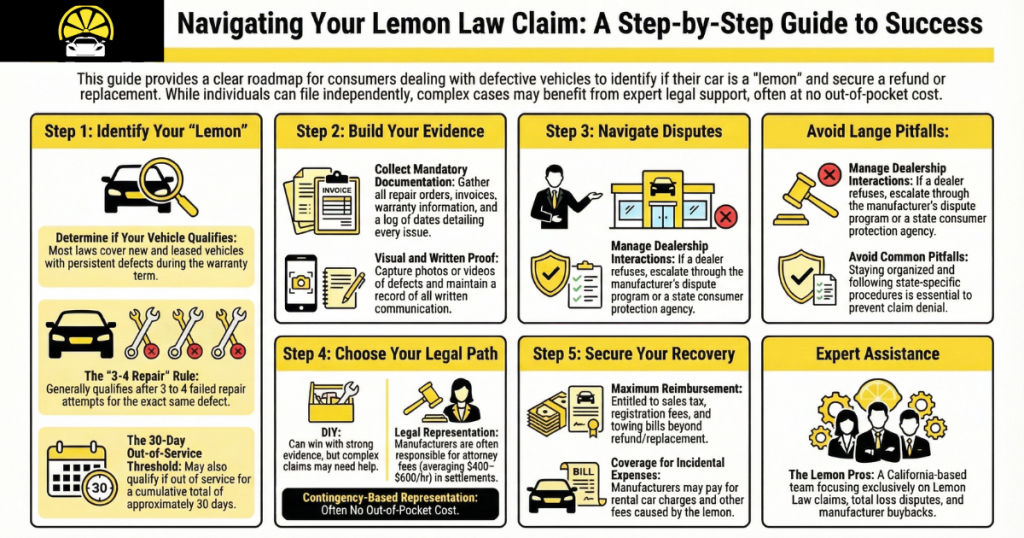
While many consumers succeed on their own, complex cases involving high-value vehicles or disputed defects may benefit from professional legal support. Choosing the right approach depends on the strength of your evidence and your comfort with the process. Unlike generic overviews, this guide provides a practical, step-by-step approach based on real claim scenarios and common mistakes we’ve seen. Instead of just explaining the law, it shows you exactly how to apply it, avoid pitfalls, and improve your chances of securing a refund or replacement without legal representation.
For great advice, you want a qualified lemon law attorney on your side, such as The Lemon Pros. Our team of Lemon Law attorneys in California focuses exclusively on California Lemon Law cases and has helped drivers pursue claims, total loss disputes, and manufacturer buybacks. Contact us today for a free case evaluation to discuss your options at no cost.
Frequently Asked Questions
This FAQ answers common concerns about filing a lemon law claim yourself, the documentation you need, repair requirements, and protections for both purchased and leased vehicles.
Can I Win a Lemon Law Case Without a Lawyer?
Yes, many consumers successfully win lemon law cases on their own by carefully documenting repairs and communication. Staying organized and following your state’s specific procedures is key to a strong claim.
What Documents Do I Need to File a Lemon Law Claim?
You should collect repair orders, invoices, warranty information, and any written communication with the dealer or manufacturer. Photos or videos of defects and a log of dates and issues can also strengthen your case.
How Many Repair Attempts Qualify Under the Lemon Law?
Most states consider a vehicle a lemon after three to four failed repair attempts for the same defect. Some laws also account for the cumulative days your car is out of service, usually around 30 days.
Are Leased Vehicles Covered by Lemon Law?
Yes, leased vehicles are generally protected under the same rules as new cars during the lease term. The lessee may be entitled to a replacement, refund, or compensation depending on the state’s law.
What if the Dealership Won’t Return My Car?
If the dealer refuses to return your vehicle, you may contact your state’s consumer protection agency or escalate through the manufacturer’s lemon law dispute program. Continuing to document all interactions is essential to protect your rights and support your claim.
Legal Disclaimer: This content is provided for informational purposes only and does not constitute legal advice. Lemon Law eligibility and outcomes vary based on individual circumstances, vehicle history, and applicable laws. Reading this article does not create an attorney-client relationship. For legal advice regarding your specific situation, consult a qualified Lemon Law attorney.